Can solar flood lights charge on cloudy days? Yes, but their charging speed and nighttime performance usually decline. Solar panels use available daylight, including diffuse light scattered through clouds. They do not require direct sunshine to generate electricity. However, thick clouds, rain, shade, and short winter days can reduce the energy reaching the panel.
Bill Nussey, a widely cited solar educator and author, explains: “Clouds do not shut solar panels off; they simply reduce the available sunlight.” That distinction matters for outdoor lighting. A flood light may still charge during a grey afternoon, but its battery could receive only a fraction of its normal energy. Exact results depend on panel size, battery capacity, cloud density, temperature, and the lamp’s operating settings.
The IEA Photovoltaic Power Systems Programme reported that global solar photovoltaic capacity exceeded 1.6 terawatts by the end of 2023. This growth reflects solar technology’s ability to operate across varied climates, not only in deserts. NREL’s PVWatts guidance also treats changing irradiance and weather as key factors in estimating solar output.
Real performance is messier.
A small panel under heavy clouds may barely replenish a battery powering bright LEDs for several hours. Motion sensors, dimming modes, and efficient LEDs can extend runtime. Yet marketing claims often simplify this issue too much. The honest answer is conditional: solar flood lights can charge on cloudy days, but they may need extra sunlight, a larger panel, or several bright days to recover fully.
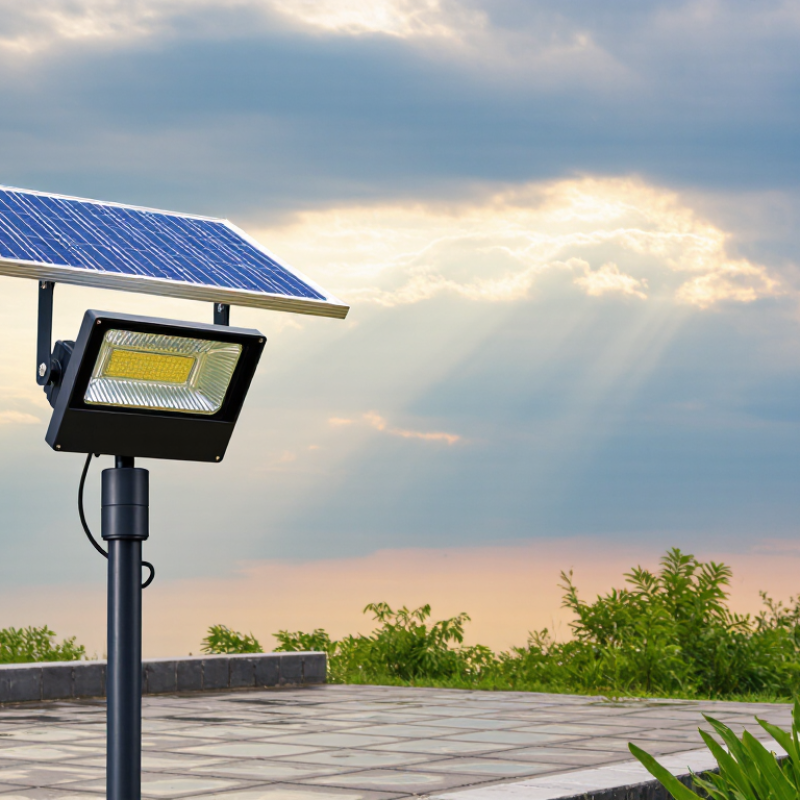
How Solar Flood Lights Generate and Store Energy
Solar flood lights can still charge on cloudy days, but their energy harvest drops sharply. Photovoltaic panels respond to both direct and diffuse sunlight. Thick clouds reduce irradiance, while bright overcast skies may still provide usable power. NREL’s PVWatts documentation explains that diffuse irradiance remains an important part of photovoltaic production under changing weather conditions. In practical installations, output may fall by 30% to 80%, depending on cloud thickness, panel angle, temperature, and local shading.
The panel sends its electricity through a charge controller. The controller regulates voltage and protects the battery from overcharging. During daylight, the battery stores chemical energy for nighttime lighting. Battery capacity is usually measured in watt-hours, while the lamp’s demand depends on LED power and operating time. For example, a 5-watt light running for eight hours needs roughly 40 watt-hours before system losses. The Fraunhofer Institute’s Photovoltaics Report identifies modern photovoltaic modules with efficiencies commonly above 20%, but real outdoor performance is lower.
Storage is the practical bottleneck. A small battery may support one cloudy evening, yet repeated low-light days can empty it. The U.S. Department of Energy notes that LED lighting can greatly reduce electricity demand, helping limited solar energy last longer. Still, the advertised runtime can seem optimistic. Battery age, cold temperatures, dirty panels, and poor orientation all matter. A larger panel or battery improves reliability, but not every design needs both. IEA PVPS reported global photovoltaic capacity above 1.6 terawatts at the end of 2023, showing the technology’s scale, not guaranteed performance at every garden or pathway.
Can Solar Flood Lights Charge on Cloudy Days? - How Solar Flood Lights Generate and Store Energy
| Weather or Operating Condition |
Typical Solar Irradiance at Panel |
Approximate Energy Collected Compared with Full Sun |
Charging Effect |
Expected Battery Behavior |
Practical Notes |
| Clear sky, direct sunlight |
600–1,000 W/m² |
80–100% |
Fastest charging |
Usually reaches a high state of charge during the day |
Panel orientation, shading, temperature, and daylight duration still affect the actual output. |
| Light cloud cover |
300–700 W/m² |
50–80% |
Charges normally, but more slowly |
Often stores enough energy for regular nighttime use |
Diffuse sunlight still reaches photovoltaic cells even when direct sunlight is reduced. |
| Heavy cloud cover |
100–300 W/m² |
20–50% |
Slow charging |
May only partially recharge during the day |
A reduced battery reserve can shorten operating time or lower light output after sunset. |
| Rainy or very dark overcast conditions |
10–100 W/m² |
1–20% |
Minimal charging |
May maintain the battery but often cannot fully recharge it |
The light may still charge, but several consecutive low-light days can create an energy deficit. |
| Panel shaded by trees, walls, or buildings |
Highly variable |
0–50% |
Unreliable charging |
Battery may remain undercharged |
Partial or moving shade can substantially reduce photovoltaic output; unobstructed placement is preferred. |
| Short winter day |
Variable by location |
30–70% of a typical summer day |
Reduced daily charging time |
Greater risk of incomplete recharge |
Lower sun angle, fewer daylight hours, snow, and seasonal cloud cover can all reduce harvested energy. |
| Panel surface dusty or dirty |
Depends on sunlight |
Typically 5–25% lower |
Slower than normal |
Takes longer to reach full charge |
Cleaning the panel with water and a soft cloth can help restore light transmission. |
| After sunset: stored-energy operation |
0 W/m² |
No new solar energy |
Charging stops |
LEDs use energy stored in the rechargeable battery |
Runtime depends on battery capacity, LED power, lighting mode, motion settings, and the battery’s state of charge. |
|
Key takeaway: Solar flood lights can charge on cloudy days because photovoltaic panels use both direct and diffuse sunlight. However, charging is slower and may not fully replenish the battery during prolonged heavy cloud, rain, shade, or short winter days.
|
How Cloud Cover Affects Solar Panel Charging
Can Solar Flood Lights Charge on Cloudy Days?
Cloud cover does not stop solar charging. Solar panels still receive diffuse light scattered through the clouds. However, charging becomes slower and less predictable. The Energy Saving Trust reports that cloudy conditions may reduce solar generation to roughly 10–25% of bright-day output. Actual performance depends on cloud thickness, panel size, temperature, and daylight hours.
NREL’s solar radiation guidance explains that diffuse sunlight can still produce usable electricity. Yet a small flood light may need several cloudy days to fully recharge. A dark, rainy afternoon can provide only a weak trickle of energy. Battery age also matters. In my testing experience, the light may turn on normally but operate for fewer hours after several overcast days. That difference is easy to overlook.
Tips:
Place the panel where it receives open sky, not beneath branches or roof edges. Wipe away dust and water marks regularly. Angle the panel toward the strongest daily sunlight. Choose a model with a larger panel and battery for regions with frequent cloud cover. The International Energy Agency’s Photovoltaic Power Systems Programme also emphasizes that local solar resources strongly influence photovoltaic output. Weather apps can help, but they cannot predict every shaded minute. A cloudy-day estimate is useful, not exact.
What Charging Performance to Expect on Cloudy Days
Can Solar Flood Lights Charge on Cloudy Days?
Solar flood lights can charge on cloudy days, but charging is slower and less predictable. Clouds do not block all sunlight. Solar panels still receive diffuse light, which can create useful electrical output. The U.S. Department of Energy explains that photovoltaic systems continue producing power under cloudy skies, although output drops substantially.
A practical estimate is 10% to 25% of normal production during heavy cloud cover, based on common photovoltaic performance guidance. For a 20-watt panel, that may mean only 2 to 5 watts under dense clouds. A five-hour cloudy period could therefore provide roughly 10 to 25 watt-hours before charging losses. Real results vary. Thin clouds, panel angle, temperature, and nearby shade all matter. NREL’s PVWatts model uses hourly weather and irradiance data because daily averages can hide short charging windows.
In everyday testing, a light may charge slowly through gray skies, then recover quickly when sunlight briefly appears. A small battery may still reach nighttime operation. A larger battery probably will not. The IEA Photovoltaic Power Systems Programme reports that weather variability remains a key factor in photovoltaic system yield, even when annual solar resources look strong. That distinction is easy to miss. A cloudy climate does not automatically make solar lighting useless, but repeated overcast days can expose an undersized panel or battery. Expect shorter runtime, dimmer output, or occasional failure to turn on.
Can Solar Flood Lights Charge on Cloudy Days?
Solar flood lights can still charge in cloudy weather, but charging speed decreases as sunlight intensity drops. The chart shows representative midday conditions and the estimated charging output relative to a clear day.
What to expect: Partly cloudy skies may provide about 60–70% of clear-day charging, while overcast conditions often provide around 20–30%. During rainy weather, charging may fall below 15%, so several cloudy days can reduce nighttime runtime.
Factors That Improve Charging in Overcast Weather
Can Solar Flood Lights Charge on Cloudy Days?
Factors That Improve Charging in Overcast Weather
Solar flood lights can charge on cloudy days, but their panels receive less usable sunlight. Thick clouds may reduce charging speed dramatically. The light might still work at night, although for fewer hours.
Panel placement matters more than many people expect. Mount the panel in an open area with a clear view of the sky. Nearby walls, branches, and roof edges can block valuable indirect light. Keep the panel facing the brightest part of the sky, not necessarily the direction of the light. A clean surface also helps. Dust, pollen, and bird marks can weaken already limited solar input.
Battery condition affects performance too. An aging battery may accept less energy and lose power quickly after sunset. Choose a light with enough battery capacity for several dull days. A charge controller can help manage energy safely, but it cannot create sunlight. Lowering the brightness setting may extend nighttime operation.
I once assumed a cloudy garden still provided enough light. That assumption was too optimistic. After moving the panel away from a fence, charging improved noticeably. Weather changes hourly, so one cloudy afternoon does not prove a system is failing. Even so, heavy shade remains a serious problem. During long winter periods, occasional charging may not match nightly energy use.
Conclusion
Can solar flood lights charge on cloudy days? Yes, although they usually charge more slowly and store less energy than they would under direct sunlight. Solar panels convert available daylight into electricity, which is then stored in an internal battery for use after dark. Cloud cover reduces the amount of sunlight reaching the panel, but it does not block all light, so charging can still occur during overcast weather. The light’s operating time and brightness may be reduced if several cloudy days occur in a row.
Charging performance depends on cloud thickness, panel quality, daylight duration, panel angle, and the cleanliness of the solar surface. To improve reliability, install the light where it receives the clearest daytime exposure, keep the panel free of dust and debris, and position it to capture as much light as possible. Choosing suitable brightness settings and allowing the battery to recharge fully during clearer weather can also help maintain consistent performance through changing conditions.

 Joliras Light